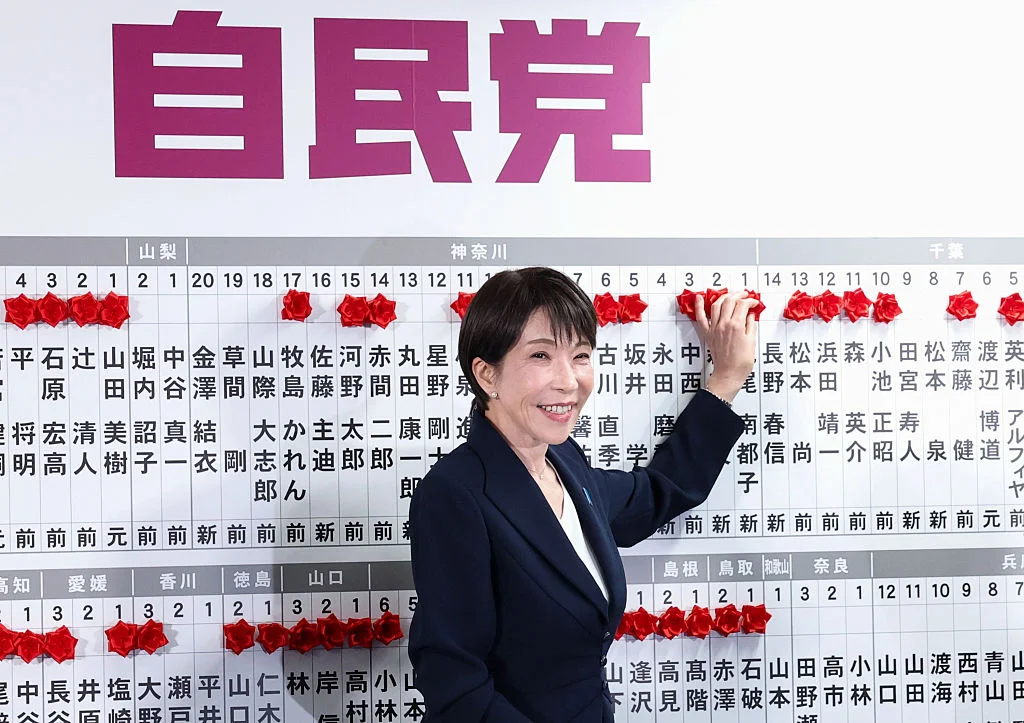
Japanese Prime Minister Sanae Takaichi made history once again after leading her party to a landslide victory in a general election on Sunday—a result that could significantly alter the country’s relationship with China and lead to deep domestic economic reforms.
[time-brightcove not-tgx=”true”]Takaichi’s decision to hold a snap election just months after her glass-breaking rise to power paid off as her Liberal Democratic Party (LDP) secured 316 of the 465 seats in the parliament’s lower house—enough to form a supermajority and a dramatic increase from the LDP and its coalition partner’s joint 232 seats before the election.
“I wanted the voters to give me a mandate because I advocated for responsible, proactive fiscal policy that would significantly shift economic and fiscal policy,” Takaichi told public broadcaster NHK late Sunday.
Takaichi, who just a few months ago became Japan’s first female Prime Minister after her predecessor Shigeru Ishiba resigned as head of the LDP amid waning support for the long-ruling party, has now presided over the LDP’s biggest electoral victory since its 1955 founding, surpassing the previous record-holding 300 lower house seats won during former Prime Minister Yasuhiro Nakasone’s Administration in 1986.
Even though Japan wasn’t due for another general election until late 2028, Takaichi called the election in hopes of capitalizing on high public approval ratings during her early tenure to gain a mandate and the legislative strength to introduce her sweeping conservative agenda.
Experts tell TIME that the LDP’s election success leaned heavily on Takaichi’s brand of leadership. Standing out for her dynamism in a party previously dominated by older men, her pledge to “work, work, work” on behalf of the country, as well as a strong social media campaign, won over disillusioned young voters.
“This was a very personal campaign,” says Jeff Kingston, a professor of Asian studies and history at Temple University’s Japan campus. “It was all about Takaichi, and they looked at her, and they looked at the other potential leaders and found them wanting.”
Takaichi campaigned on a tougher stance toward China, rebuilding Japan’s military, tougher immigration rules, and economic reforms. She also earned the “complete and total endorsement” of U.S. President Donald Trump, with whom she has established a strong working relationship.
Trump congratulated Takaichi on her “LANDSLIDE Victory” in a post on Truth Social on Sunday.
Here’s what you need to know about what comes next.
A loyal legislature
Kingston says the LDP’s success, buttressed by an additional 36 seats won by its coalition partner Japan Innovation Party, effectively allows Takaichi to pursue whatever policies she wants. “The opposition has been decimated,” he says. “There’s really no guardrails out there.”
Jeffrey Hall, a lecturer at Kanda University of International Studies in Japan, adds that many of the LDP’s new victors, including some who lost their seats in 2024, are now effectively Takaichi’s “children.” They’ll look to her “for protection,” he says, and they’ll be expected to “support their political mom.”
Change in Japan-China relations
Experts say that the LDP’s resounding win signals an end for now to Japan’s “revolving-door” politics. And with Takaichi presumed to have years remaining in power, China will have to navigate the increasingly tense relationship her early Administration has already exhibited.
Shortly after taking office, Takaichi made waves by publicly stating that Japan might respond to an invasion of Taiwan, noting that such an invasion could trigger collective self-defense and a “survival-threatening situation.” She has also said she would bolster Japan’s military, further eroding decades of pacifist policy that began after World War II.
Takaichi’s comments provoked the ire of China, which views Taiwan as part of its territory. Beijing has responded with attempts to isolate Japan, telling Chinese tourists to “avoid traveling” there in the near future and reimposing a ban on Japanese seafood imports.
Read More: How the China-Japan Rift Could Cost Both Countries
But domestically, while opponents have criticized her hawkishness, nationalists have cheered Takaichi’s unwillingness to cower to China’s pressure campaign.
“China initially assumed she would be a short-lived leader, based on recent past,” Kingston says. “They ratcheted up the wolf-warrior diplomacy, denounced her, vilified her, and demanded she retract. And what they did is inadvertently boost her popularity among the Japanese, because people rallied behind her against the regional bully.”
Taiwan’s President Lai Ching-te, meanwhile, was among the first foreign leaders to congratulate Takaichi, saying on X that he looks forward to facing “regional challenges together in the spirit of shared values and mutually beneficial cooperation, thereby promoting peace and prosperity in the Indo-Pacific region.” And in his congratulatory post, Trump praised Takaichi’s “Peace Through Strength Agenda.”
Economic reforms
Domestically, Takaichi, who counts former conservative U.K. Prime Minister Margaret Thatcher as her political hero, has pledged drastic economic reforms.
Among them is a plan to suspend the 8% consumption tax on food to ease the burden of rising prices on households.
“We will accelerate talks over a sales tax reduction,” Takaichi told reporters in the aftermath of the election on Sunday.
Takaichi also promised partial tax deductions for babysitting expenses and corporate tax incentives for companies that offer in-house childcare—a sign that she may be warming to more family-friendly policies.
“We will prioritise the sustainability of fiscal policy. We will ensure necessary investments. Public and private sectors must invest. We will build a strong and resilient economy,” she said Sunday.
Constitutional amendment
Takaichi may try to use her sweeping political mandate to push through structural change. The LDP has long sought to revise Article 9 of the Japanese Constitution, which establishes Japan’s pacifist approach to conflict and dispute resolution and prohibits the maintenance of air, ground, and maritime military forces.
“Why can’t we write the Self-Defense Forces into the Constitution?” Takaichi said in a Feb. 2 speech. “I want you to let us revise the Constitution to position them as an effective organization.”
But while the party now has a supermajority in the lower house, it doesn’t have the same in the upper house. And amending the constitution would be an uphill battle, requiring support from two-thirds of lawmakers in both chambers as well as a public referendum.
Stephen Nagy, a professor of international relations at the International Christian University in Tokyo and a visiting fellow with the Japan Institute for International Affairs, says that Takaichi “might be misreading the mandate if she focuses on constitutional revision.” He believes that many of the people who backed her did so with inflation, cost of living, affordability and wages top of mind.
Gender politics
Though Takaichi made history as the country’s first female Prime Minister in October 2025, her stance on gender and sexuality politics has prompted mixed reactions to her rise.
Takaichi supports the imperial family’s male-only succession and opposes same-sex marriage as well as amending the 19th-century law requiring married couples to have the same surname, under which most women are pressured into abandoning theirs. While there is growing support in Japan for couples to be able to have different surnames, Takaichi said the practice “may destroy the social structure based on family units.”
“She doesn’t have a very positive track record on gender issues, on family-friendly policies, women’s empowerment,” Kingston told TIME last year.