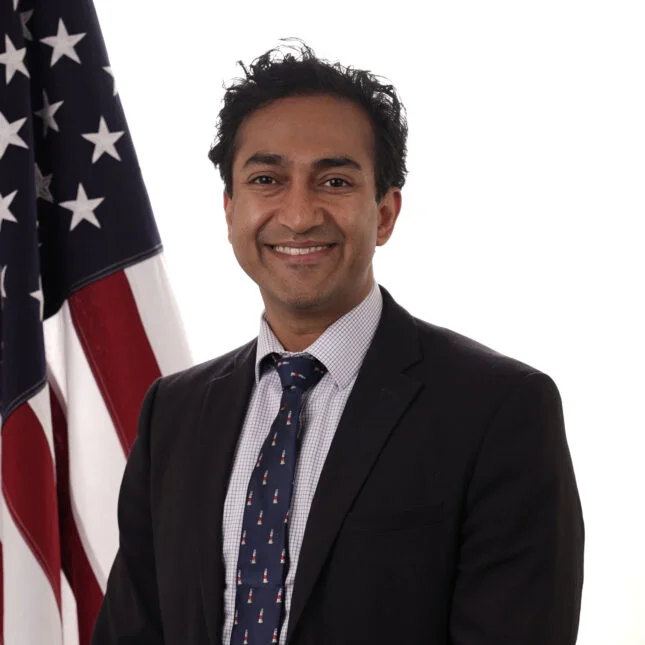

WASHINGTON — Vinay Prasad, a senior FDA official whose tenure at the agency was defined by a succession of high-profile disputes and institutional friction, is stepping down from his post for the second time.
Prasad's exit from the FDA is scheduled for the close of April, with no successor yet designated. FDA Commissioner Marty Makary disclosed the departure in remarks to The Wall Street Journal.
An agency spokesperson verified the news of Prasad's imminent departure. Prasad had not responded to STAT's requests for comment at the time of publication.
In a social media post, Commissioner Makary offered an appreciative send-off, crediting Prasad with a range of regulatory accomplishments: streamlining clinical trial requirements for drug approval, restricting Covid vaccine authorization to adults over 65 and those with qualifying risk factors, establishing a new regulatory pathway for personalized medicines, and co-architecting a fast-track drug review initiative. Makary echoed these sentiments in an internal staff memorandum reviewed by STAT.
"He got a tremendous amount accomplished within his one-year sabbatical from UCSF and will be returning back to his academic home later next month," Makary said. "We will name a successor before his departure."
The announcement arrives against a backdrop of mounting institutional turbulence. The Center for Biologics Evaluation and Research, which falls under Prasad's jurisdiction, has issued a string of contested rulings on rare disease therapeutics in recent months. The timing is further complicated by an unusual public intervention: just one day prior, a senior official at the Department of Health and Human Services — the FDA's parent agency — convened a press briefing during which they openly criticized an experimental Huntington's disease treatment currently under regulatory review, a highly atypical move for a therapy still navigating the approval process.
Prasad's exit is the latest in a prolonged wave of high-level departures that has reshaped the Trump-era FDA's leadership landscape. The Center for Drug Evaluation and Research alone cycled through five different directors over the course of 2025. Richard Pazdur, a veteran oncology drug regulator with decades of institutional knowledge, stepped down from his CDER directorship in December, citing what he characterized as political encroachment on the agency's scientific decision-making. Before Pazdur, George Tidmarsh departed under a cloud of allegations suggesting he had weaponized his regulatory authority against a former biotech associate — claims Tidmarsh has firmly denied. Meanwhile, mid-tier agency leadership has eroded steadily, with officials departing through a combination of forced exits and voluntary attrition at a consistent pace.
Prasad, a board-certified oncologist who simultaneously held the title of FDA chief scientific and medical officer, commanded regulatory oversight of vaccines, gene and cell therapies, and blood-derived biologics. Before entering federal service, he built a reputation at the University of California San Francisco as a sharp-tongued critic of medical orthodoxy, challenging the evidentiary foundations of clinical trial methodologies and scrutinizing entrenched ties between the pharmaceutical industry, the medical establishment, and regulatory bodies.
The paradox of Prasad's tenure at CBER was a persistent tension between the agency's stated commitment to regulatory flexibility and the center's increasingly rigorous — critics would say restrictive — posture toward rare disease drug applications.
Under his watch, CBER declined to approve at least five cell and gene therapy candidates that industry analysts and clinical experts widely believed would have cleared the bar under prior FDA leadership.
In several instances, pharmaceutical sponsors have alleged that the agency reneged on previously negotiated agreements regarding clinical trial design parameters. One illustrative case involved a treatment for a rare hematologic malignancy that had been advancing steadily toward approval before the agency issued a rejection last month, citing data quality concerns that the sponsor maintained had already been satisfactorily resolved through prior regulatory dialogue.
These regulatory reversals have deeply unsettled rare disease patient advocacy communities, who have grown increasingly skeptical that the agency's public messaging around embracing flexibility for underserved patient populations is being translated into meaningful action at the review level.
Prasad's relationship with the FDA has itself been turbulent. He assumed the CBER directorship in May 2025, only to be dismissed in July following a controversy over his handling of a Duchenne muscular dystrophy treatment that alienated both rare disease advocacy groups and far-right influencer Laura Loomer, a figure with direct access to President Trump. The administration subsequently reversed course within weeks, reinstating him at Makary's urging.
His return, as STAT previously reported, was not accompanied by any apparent recalibration of his management philosophy. Among his earliest actions upon reinstatement was the removal of the official overseeing vaccine safety and surveillance — a role Prasad subsequently assumed himself. He ultimately displaced at least seven agency leaders from their positions. In October, eight FDA insiders told STAT that Prasad had cultivated an institutional culture characterized by pervasive mistrust and operational paranoia.
Despite the internal friction, Prasad wielded considerable influence over some of the FDA's most consequential policy initiatives. As chair of the committee evaluating drug submissions designated with a "Commissioner's National Priority Voucher," which mandates a regulatory determination within one to two months, Prasad gained leverage over drug review decisions that technically fell outside CBER's jurisdiction. He also championed vaccine regulatory standards that a coalition of former FDA commissioners argued could effectively foreclose the development pipeline for next-generation vaccine products. Together with senior drug regulator Tracy Beth Høeg, Prasad engineered a transfer of vaccine surveillance authority away from career scientific staff. In one of his most visible recent interventions, Prasad overrode agency staff by blocking the review of a new Moderna influenza vaccine — a decision the FDA ultimately reversed following pressure from the White House, as the agency agreed to proceed with the evaluation.
The broader regulatory environment at both the FDA and affiliated public health agencies has shifted markedly toward vaccine skepticism under Health Secretary Robert F. Kennedy Jr., a longtime and vocal critic of immunization policy.
Prasad, a California resident, maintained only a part-time physical presence at the FDA's Silver Spring, Maryland headquarters, appearing on campus just a few days each week. Despite this arrangement, staff members described an executive who sought disproportionate administrative control over his workforce from a distance — mandating, for instance, that all subordinates maintain fully transparent calendar access while keeping his own scheduling information confidential. He also directed staff to bypass their direct supervisors and refrain from disclosing when he had requested one-on-one meetings with them.
At the height of the internal tensions, four agency officials confirmed to STAT that multiple employees had formally lodged complaints regarding Prasad's management conduct with the agency's human resources division.