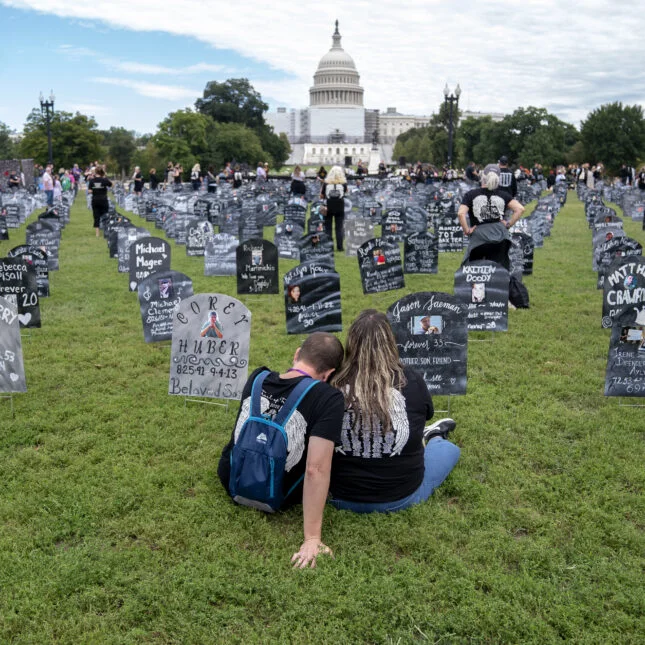
When the Centers for Disease Control and Prevention released data in May 2025 confirming that drug overdose fatalities had declined by 27% — plummeting from approximately 110,000 in 2023 to around 80,000 in 2024 — the public health community responded with cautious optimism. Provisional figures extending through late 2025 suggest a continued trajectory downward, toward an estimated 72,000 deaths.
Speaking as both an addiction researcher at Stanford and an individual with lived experience of long-term recovery, I absorbed that announcement with an almost involuntary sense of relief. Around me, colleagues who had spent years sounding alarms finally allowed themselves to breathe. The tension that had become institutional — embedded in every research meeting and policy briefing — momentarily lifted.
After more than two decades of unrelenting escalation, the overdose mortality curve had at last reversed direction. Political leaders seized on the moment, declaring "unprecedented progress." The CDC framed the numbers in terms of lives preserved — more than 81 every single day.
Both characterizations are defensible. Saving more than 81 lives daily is a genuine, tangible achievement. And yet, precisely because of that, this moment demands sober scrutiny rather than uncritical celebration.
Consider what those figures actually represent: an annual death toll that still surpasses the total number of American combat casualties sustained throughout the entire Vietnam War — and it repeats, year after year. When overdose deaths first crossed the 50,000 threshold in 2015, the nation treated that milestone as a profound moral failure demanding urgent intervention. A decade on, 50,000 deaths has been quietly recast as an aspirational benchmark — something to strive toward from above, rather than a floor to push through from below. That fundamental inversion of expectations is not a sign of progress. It is a symptom of collective desensitization to catastrophe.
This pattern — the gradual absorption of mass death into the ordinary background noise of societal life — has well-documented historical precedents in public health. I have come to describe this phenomenon as the emergence of a "stable floor": the critical inflection point at which a mortality figure ceases to register as an emergency requiring structural response and instead becomes institutionalized as the unremarkable cost of maintaining existing social arrangements.
The trajectory of drunk driving fatalities offers the most instructive parallel. When federal surveillance systems began capturing comprehensive data in 1982, approximately 21,000 Americans were dying annually in alcohol-impaired crashes. That figure reflected a convergence of structural failures: inconsistent minimum drinking ages across states, a deeply entrenched cultural permissiveness toward impaired driving, and vehicle fleets lacking contemporary safety engineering. Public reaction was visceral and immediate. Mothers Against Drunk Driving transformed grassroots grief into legislative momentum; Congress enacted a national minimum drinking age of 21; states moved to standardize blood alcohol content thresholds at 0.08; and sobriety checkpoints became routine enforcement tools. The cumulative effect was dramatic — fatalities fell by nearly half by the mid-1990s.
Then the momentum quietly dissipated. Sustaining further reductions would have required politically uncomfortable structural commitments — substantial public transit expansion, significant alcohol tax increases, or universal mandates for ignition interlock technology. None of these interventions, despite meaningful evidentiary support, ever achieved sufficient political viability to be enacted at scale.
The consequence has been decades of stagnation. For more than thirty years, between 10,000 and 13,000 Americans have perished annually in alcohol-related crashes. These deaths no longer generate candlelight vigils or congressional hearings. They have been absorbed into the actuarial calculus of a society that has collectively decided this toll is the acceptable price of its relationship with alcohol and automobiles.
The same normalization dynamic is now actively threatening to capture the overdose crisis. In 2017, a presidential declaration of public health emergency was triggered when the annual death count reached approximately 70,000. When fatalities surpassed 100,000 in 2021, the response was renewed institutional urgency — congressional hearings, emergency appropriations, and expanded federal coordination. Now, with deaths having receded back toward the threshold that originally justified emergency status, the dominant political and media narrative has pivoted from alarm to vindication. We are measuring our success not against any principled standard of tolerable mortality, but against the worst recorded years of the epidemic itself.
The leading indicators of an emerging stable floor are already visible. The rate of decline is losing momentum. Following the 27% reduction recorded in 2024, provisional surveillance data for 2025 reflects only a 19% year-over-year decline, with individual states already recording upticks that suggest uneven geographic distribution of whatever progress is being made.
More troubling still is the active dismantlement of the programmatic infrastructure responsible for driving that decline. The previous year saw the White House withhold approximately $140 million in CDC grants earmarked for community-level overdose surveillance and harm reduction programming, compounded by personnel reductions at the agency's injury prevention division.
The proposed federal budget framework for fiscal year 2026 signals even deeper reductions targeting both the CDC and the Substance Abuse and Mental Health Services Administration. The decision to defund overdose monitoring, evidence-based treatment infrastructure, and harm reduction programming at the precise historical moment when those investments are demonstrating measurable efficacy is not a policy disagreement about resource allocation — it is normalization made manifest in legislative form.
Some observers will contend that invoking the specter of stagnation is premature while mortality figures continue their downward trajectory. That objection fundamentally misreads the mechanics of normalization. The stable floor does not materialize after progress ends — it takes shape while progress is still occurring, when declining numbers become the political justification for reduced investment and the avoidance of harder structural choices. The drunk driving movement did not fail in the aftermath of its victories; it failed at the moment those victories were redefined as sufficient, and 10,000 annual deaths became the implicit social contract.
The intervention modalities currently producing measurable reductions in overdose mortality — broad-scale naloxone distribution, expanded access to medications for opioid use disorder, fentanyl test strip availability, and data-driven epidemiological surveillance — constitute a genuine evidence base for effective public health practice. But their effectiveness is entirely contingent on sustained funding, reliable distribution networks, and active political defense. Whether the current decline catalyzes continued institutional investment or licenses political withdrawal remains the defining question of this moment in addiction policy.
The essential question confronting us is not whether 72,000 annual deaths represents an improvement over 110,000. Self-evidently, it does. The question is whether 72,000 deaths constitutes an acceptable societal outcome. And if we determine that it does not, will we similarly refuse to accept 52,000? Because in the absence of a principled, explicit answer to that question, the answer will be written for us — incrementally, quietly, through the same unremarkable arithmetic that has kept drunk driving fatalities locked between 10,000 and 13,000 for more than a generation.
Wayne Kepner, Ph.D., M.P.H., is a postdoctoral fellow in the Department of Psychiatry and Behavioral Sciences at Stanford University School of Medicine. His research focuses on addiction health services and policy.