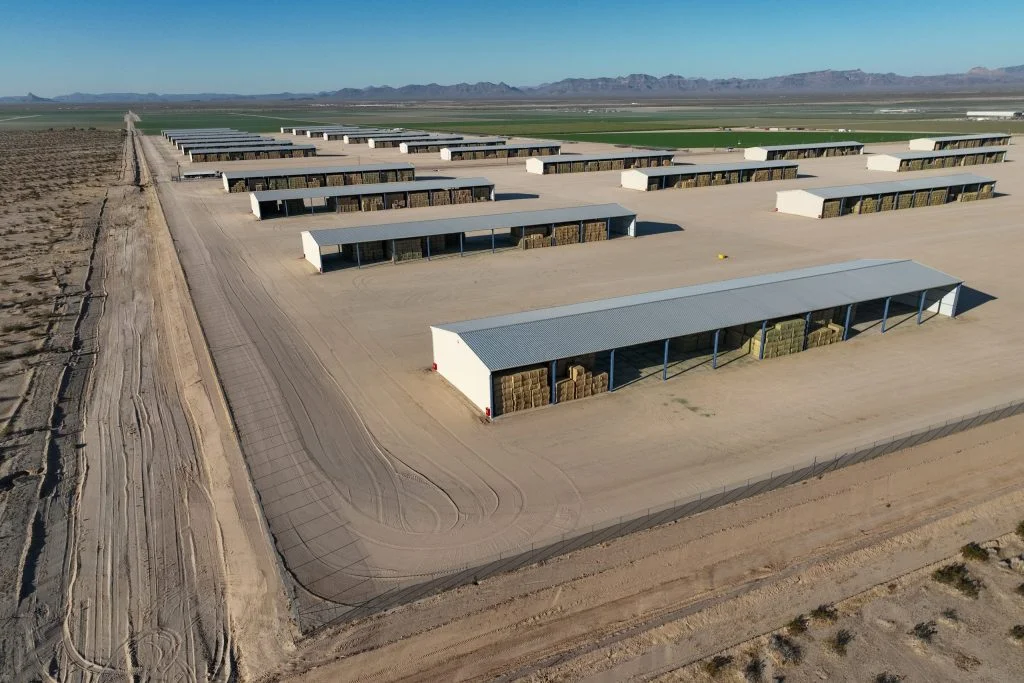
Arizona's top law enforcement official has filed a landmark lawsuit against a Saudi-controlled agricultural enterprise conducting an enormous alfalfa cultivation operation in the heart of the Sonoran Desert, asserting that the corporation's activities are dramatically accelerating the depletion of a fragile groundwater system that entire rural communities depend on for survival.
Operating under the name Fondomonte, the Saudi-owned agribusiness extracts billions of gallons of underground water annually from La Paz County's aquifer system — irrigating vast stretches of arid desert terrain to cultivate hay crops that are subsequently exported to the Middle East to sustain dairy livestock operations thousands of miles away.
The foreign-owned agricultural venture first attracted public scrutiny through a 2015 investigation by the Center for Investigative Reporting, igniting immediate and widespread anger across the state and triggering extensive coverage from national and even international press outlets.
Arizona Attorney General Kris Mayes had signaled to CIR the previous year that legal intervention was under serious consideration. On Wednesday, she formally announced the filing of a public nuisance lawsuit — a legal instrument that calls on the court to halt Fondomonte's excessive groundwater extraction and compel the company to establish a remediation fund designed to compensate neighboring residents whose wells have run dry or whose water quality has significantly deteriorated as a direct consequence of the industrial-scale pumping.
"Arizona law is clear: No company has the right to endanger an entire community's health and safety for its own gain," Mayes said in a statement.
Arizona Department of Water Resources Director Tom Buschatzke initially dismissed CIR's 2015 investigation as sensationalist reporting that overstated the threat, arguing in the Arizona Republic that "there is a sufficient water supply available in this area of La Paz County for at least the next 100 years."
Reality, however, told a starkly different story. Residential wells belonging to properties surrounding Fondomonte's operations began failing not long after those assurances were made. The compounding human toll of the farm's impact on the local water table was subsequently documented in the feature film The Grab, a full-length documentary examining global food and water security conflicts, reported and produced by the Center for Investigative Reporting.
By 2017, the well serving the Friendship Baptist Church — located directly adjacent to the farm — had completely run dry, forcing the congregation's pastor to haul in bottled water for baptismal ceremonies and community gatherings. John Weisser, a rancher whose property sits near the Saudi operation, similarly reported his well had failed, explaining to the documentary team that declining water tables had outpaced any natural replenishment: "because the water's dropping. There's not enough rain that could replenish it."
Wayne Wade, a trailer park resident in proximity to the farm, described encountering the same crisis.
"The water level went below my pump, and the pump burned up and melted the casing," Wade said. "I think everybody knows the problem, but I don't know how to correct it. I can't pay for a high-powered lawyer. Neither can any of my friends."
La Paz County Supervisor Holly Irwin has been sounding alarms and pleading for state intervention ever since the Saudi-owned farm's operations first became public knowledge nearly a decade ago. With the attorney general's office now formally entering the arena, Irwin expressed a profound sense of relief: "I feel that La Paz County finally has someone fighting for us," she said. "My constituents are experiencing real damages from massive groundwater pumping."

Mayes, who assumed office following her 2022 election victory, characterized the state's longstanding practice of permitting Fondomonte and comparable large-scale agricultural operations across rural Arizona to extract unlimited groundwater volumes — bearing no cost beyond their electricity expenditure for running the pumps — as a fundamental and consequential failure of regulatory governance.
"Why are we allowing a Saudi-owned corporation to stick a straw in the ground and suck so much of our water out and send alfalfa back to Saudi Arabia and not charge them a dime for the water? It is bonkers," Mayes told Reveal last year. "Water in Arizona is life. Our very survival as a state depends on our doing better when it comes to water."
The geopolitical dimensions of this dispute carry significant historical weight. During the mid-1990s, Saudi Arabia ranked among the world's leading wheat exporters. However, as intensive domestic agriculture systematically exhausted the kingdom's own underground water reserves, the Saudi government directed agricultural corporations to seek out new water sources beyond the country's borders — effectively exporting the environmental consequences of industrial farming to host nations with weaker regulatory frameworks.
"Fondomonte came to Arizona to extract water at an unreasonable and excessive rate because doing so was banned in its home country—another arid desert with limited water," the lawsuit alleges. "Fondomonte is taking advantage of Arizona's failure to protect its precious groundwater resource."
Fondomonte categorically rejected the charges in an official statement, dismissing the allegations as entirely without merit.
"We will defend any potential action against Fondomonte and our rights vigorously before the competent authorities," the statement said.
Arizona Sues Saudi-Owned Farm Draining Groundwater in the Desert is a story from Reveal. Reveal is a registered trademark of The Center for Investigative Reporting and is a 501(c)(3) tax exempt organization.