This story was published in partnership with The Trace, a nonprofit newsroom covering gun violence in America. Sign up for its newsletters here.
On a September 2022 evening in Milwaukee, Officers Yang Lee and Charles Laskey-Castle responded to a call about an abandoned vehicle on the city's west side. As Lee crouched to inspect the driver's side floorboard, his partner positioned himself directly behind him. When Lee stood up, his holstered SIG Sauer P320 discharged—sending a round into Laskey-Castle's leg without anyone touching the trigger.
Body-worn camera footage documented the entire incident. Court filings and departmental records indicate this was at minimum the third documented instance within a three-year window in which a Milwaukee officer's P320 allegedly discharged spontaneously—without any deliberate trigger engagement. Within weeks, the Milwaukee Police Department initiated procurement proceedings to transition its entire sidearm inventory to a competing manufacturer.
"There is no higher priority than the safety of the people who protect our city," Milwaukee Mayor Cavalier Johnson stated at an October 2022 press conference announcing the transition. "Unexplained discharges, they have injured people. That's completely unacceptable to me."
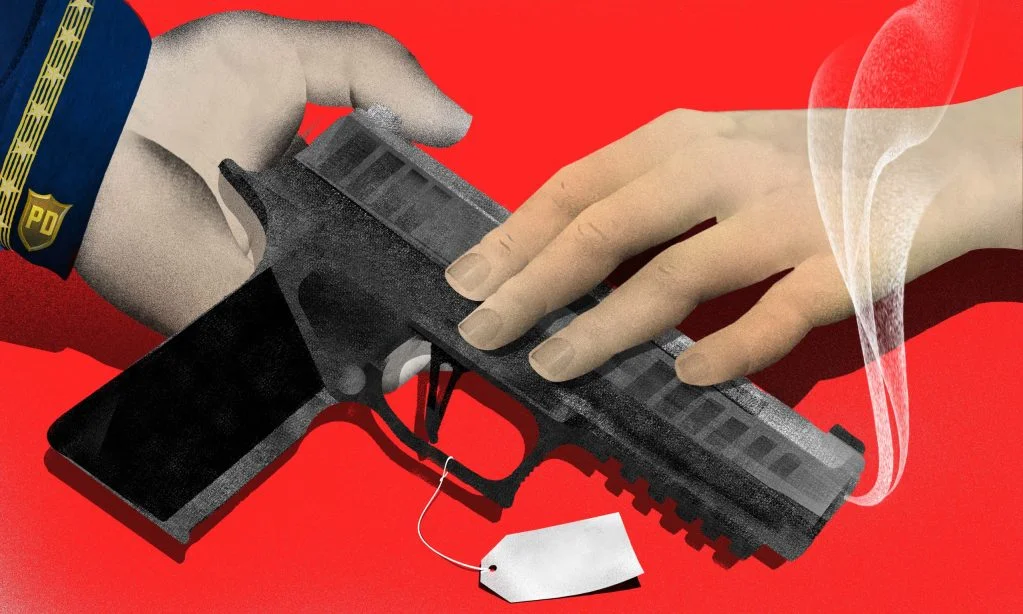
At that same announcement, Milwaukee's police chief disclosed a significant operational detail: to defray the acquisition costs of the replacement firearms, the department intended to liquidate its decommissioned P320 inventory through a licensed gun dealer. In a striking turn of public safety policy, weapons deemed unfit for sworn officers would soon be reintroduced into the civilian commercial market.
Milwaukee's decision is far from an isolated case—it reflects a broader institutional pattern unfolding across American law enforcement as agencies grapple with mounting evidence of the P320's reliability issues. A 2023 investigation by The Trace and the Washington Post documented that the P320 had severely injured numerous individuals, many of whom pursued litigation alleging a potentially life-threatening mechanical defect. SIG Sauer has consistently refuted these allegations.
Over a two-month period, The Trace conducted a systematic survey of more than 60 law enforcement agencies whose personnel had been issued the P320. The findings were striking: more than 20 agencies—among them the police departments of Oklahoma City, Denver, and Chicago—had formally prohibited the firearm due to documented concerns about unsanctioned discharges. Twelve agencies confirmed they had subsequently resold their decommissioned P320s on the civilian market after concluding the model posed unacceptable risks to officers in the field.
Across all surveyed departments, the cumulative volume of P320s redirected back into commercial circulation reached at least 4,000 firearms.

"If the primary function of law enforcement is to protect and serve, one would think that returning a problematic weapon to the public is not particularly consistent with that mission," Jonathan Jacobs, director of the Institute for Criminal Justice Ethics at New York's John Jay College, told The Trace. "The ethical issues here are very, very plain."
A Milwaukee police spokesperson offered a straightforward rationale: "The trade-in was a cost-savings for the department."
SIG Sauer declined to address the particulars of this reporting and instead directed all inquiries to p320truth.com, a company-operated informational site dedicated to the firearm. The manufacturer has maintained throughout that the P320 cannot discharge without deliberate trigger actuation, and has pointed to unintentional discharge incidents involving other manufacturers' firearms as evidence that such occurrences are neither exceptional nor indicative of an inherent design flaw specific to their product.
Concerns Grow After Multiple Shootings, Lawsuits
The controversy has gained considerable traction in Washington State, where the Criminal Justice Training Commission took decisive action in February, formally prohibiting the P320 from all its facilities. The commission's decision, which cited an "abundance of allegations of un-commanded discharges occurring around the country," carried significant institutional weight—given that the commission oversees mandatory training programs for law enforcement personnel statewide, its prohibition effectively compelled agencies across Washington to reassess their continued reliance on the platform.
The regulatory action followed at least two documented P320 discharge incidents within Washington law enforcement ranks. In one case last year, a Kitsap County sheriff's deputy's holstered P320 fired spontaneously while she was actively detaining a suspect inside a grocery store, according to body camera footage reviewed by local media. While no injuries resulted, the Kitsap County Commission subsequently offered to fully finance the procurement of replacement sidearms and cover the cost of permanently destroying the decommissioned P320s—effectively removing them from any downstream circulation.
The Sheriff's Office rejected that offer and announced in March that it would instead liquidate more than 200 P320s through a commercial dealer. "It seemed like the fiscally responsible thing to do," Kitsap County Undersheriff Russ Clithero told The Trace. The resale generated roughly $300 per unit—a total exceeding $60,000 in recovered value.
The P320 ranks among the most widely adopted service pistols in American law enforcement, deployed across more than a thousand agencies nationwide. Yet according to an accumulation of police incident reports and civil litigation records, at least 120 individuals had alleged—as of April 23—that their P320 discharged without any trigger engagement. Those incidents produced more than 110 documented injuries and at least one fatality, painting a troubling picture of the weapon's real-world performance outside controlled testing environments.
Litigation against SIG Sauer over P320 discharges has grown substantially. While several cases have been dismissed and the company secured a jury verdict in its favor in 2022, the legal tide has recently shifted. Two subsequent juries have ruled against the manufacturer, resulting in combined damages exceeding $13 million. Following the most recent adverse verdict in November, the national Fraternal Order of Police dispatched a formal letter to SIG Sauer demanding a comprehensive accounting of the company's remediation efforts in response to the mounting safety concerns surrounding the P320.
"The officers who rely on your products must have absolute confidence in the safety and performance of their weapon," the letter read.
For this investigation, The Trace reached out to 69 law enforcement agencies, of which 41 provided responses. Among those, 16 confirmed that concerns about the P320's operational safety had directly driven their decision to transition to alternative sidearms. An additional four agencies had already acknowledged publicly that safety considerations motivated their switch, though they did not respond to The Trace's outreach.
Florida's Pasco County Sheriff's Office liquidated more than 800 P320s following three separate incidents in which deputies reported their holstered weapons discharging without trigger activation—all three officers survived, according to departmental records.
"The trade-in value was necessary to facilitate the transition to the Glocks we currently use," a Sheriff's Office spokesperson stated. "We cannot speak for what actions the vendor took with the weapons after we traded them back."
The Bridge City, Texas, Police Department similarly offloaded its P320 inventory after one of its officers reported being shot in the groin by her own holstered weapon—which was secured inside a zipped purse at the time, according to the official police report. The projectile came within inches of her spine.
R.D. Bergeron, Bridge City's assistant police chief, noted that the department retained the specific firearm involved in that incident. "The last thing we would want is anyone, officer or civilian, to get hurt due to it firing uncommanded," Bergeron said.
A Common Police Practice
The secondary-market resale of decommissioned law enforcement firearms is a well-established institutional practice, driven primarily by budgetary pressures. Former police-issue handguns command reliable demand among civilian buyers, who prize them for their competitive pricing and typically well-maintained condition. Nevertheless, the practice has attracted sustained criticism from criminologists and public safety researchers, who argue that channeling retired police weapons back into civilian hands contributes measurably to downstream criminal activity.
The scale of the problem is considerable: an investigation by The Trace, CBS News, and Reveal from The Center for Investigative Reporting documented that at least 52,000 former police firearms had been linked to criminal activity—including homicides and violent assaults—since 2006. While some of those weapons were stolen or lost, a significant portion had entered civilian hands through deliberate departmental resale programs.
Ed Obayashi, a deputy sheriff in Modoc County, California, and a nationally recognized police ethics authority, argues that reselling a weapon with known or alleged defects introduces a qualitatively different and more acute public safety risk—entirely separate from the criminal diversion concern. In his assessment, no department that genuinely believes its P320s to be defective can ethically justify returning them to market circulation. "There are situations in law enforcement where you're going to have to do the right thing, even if it's going to cost you financially," Obayashi said.
In Laredo, Texas, the Police Department resold approximately 500 P320s following an officer's reported spontaneous discharge. The officer sustained no injuries, but a subsequent forensic examination by the Bexar County Criminal Investigations Laboratory—documents from which were obtained by The Trace—concluded that the weapon had discharged "without the trigger being pulled."
A Laredo police spokesperson did not respond to questions regarding the department's rationale for returning the decommissioned firearms to commercial sale rather than destroying them.
Beyond the twelve agencies that routed their P320s through commercial dealers, two additional organizations took a different approach: the Southeastern Pennsylvania Transit Authority (SEPTA) and the Honesdale Borough Police Department, both in Pennsylvania, returned their firearms directly to SIG Sauer, according to The Trace's findings.
SEPTA initiated its return after an officer's P320 discharged inside a Philadelphia subway station, narrowly avoiding a serious injury. SEPTA spokesperson Andrew Busch acknowledged that the agency had no mechanism to impose conditions on what the manufacturer might subsequently do with the returned weapons. When pressed on whether retaining and destroying the firearms had been considered, Busch declined to engage: "We are not going to comment on internal deliberations or discussions with the manufacturer."
Among the nation's largest metropolitan law enforcement agencies—many of which operate approved-carry lists rather than issuing a single standardized sidearm—five departments contacted for this story confirmed they had either already removed the P320 from their authorized firearms rosters or were actively moving to do so on safety grounds. These included the Chicago, Denver, and Dallas police departments, along with the Clark County and Pierce County sheriff's offices in Washington State.
"The SIG Sauer P320 was found to no longer meet the internal safety standards of the Denver Police Department," a departmental spokesperson stated in a written response.
Sixteen additional agencies surveyed either expressed continued confidence in the P320's performance or indicated that their transition to different platforms had been driven by non-safety considerations—such as accessory compatibility or departmental standardization preferences—rather than concerns about involuntary discharge.
Goshen, Indiana, Police Chief José Miller offered a pointed counterpoint, characterizing the P320 as a proven and dependable service weapon following more than a decade of operational deployment by his department. "Our evaluation—bolstered by both our internal experience and external research, including findings from the Department of the Army—leaves no doubt," Miller said. "The SIG Sauer P320 is a safe, dependable firearm."
Among all the agencies surveyed, only one—the Orange, Connecticut, Police Department—chose neither to resell nor return its decommissioned P320s. Those weapons remain secured in departmental storage. "If we believe a firearm might be defective, we don't agree with putting that weapon back on the street," said Max Martins, the department's assistant chief. "What if we traded in the guns, then a civilian bought one of our old ones and there was an accidental discharge? You don't want that on your conscience."
A Gun Deemed Too Dangerous for Cops, But Fine for Civilians is a story from Reveal. Reveal is a registered trademark of The Center for Investigative Reporting and is a 501(c)(3) tax exempt organization.